Description
In The Space We Move Into, Marie-Chloé Duval explores the invisible architecture shaped by movement, memory, and the transient presence of organic forms. Suspended floral-like fragments drift through a softly constructed geometric interior, where translucent planes and shifting perspectives suggest spaces that are both physical and psychological.
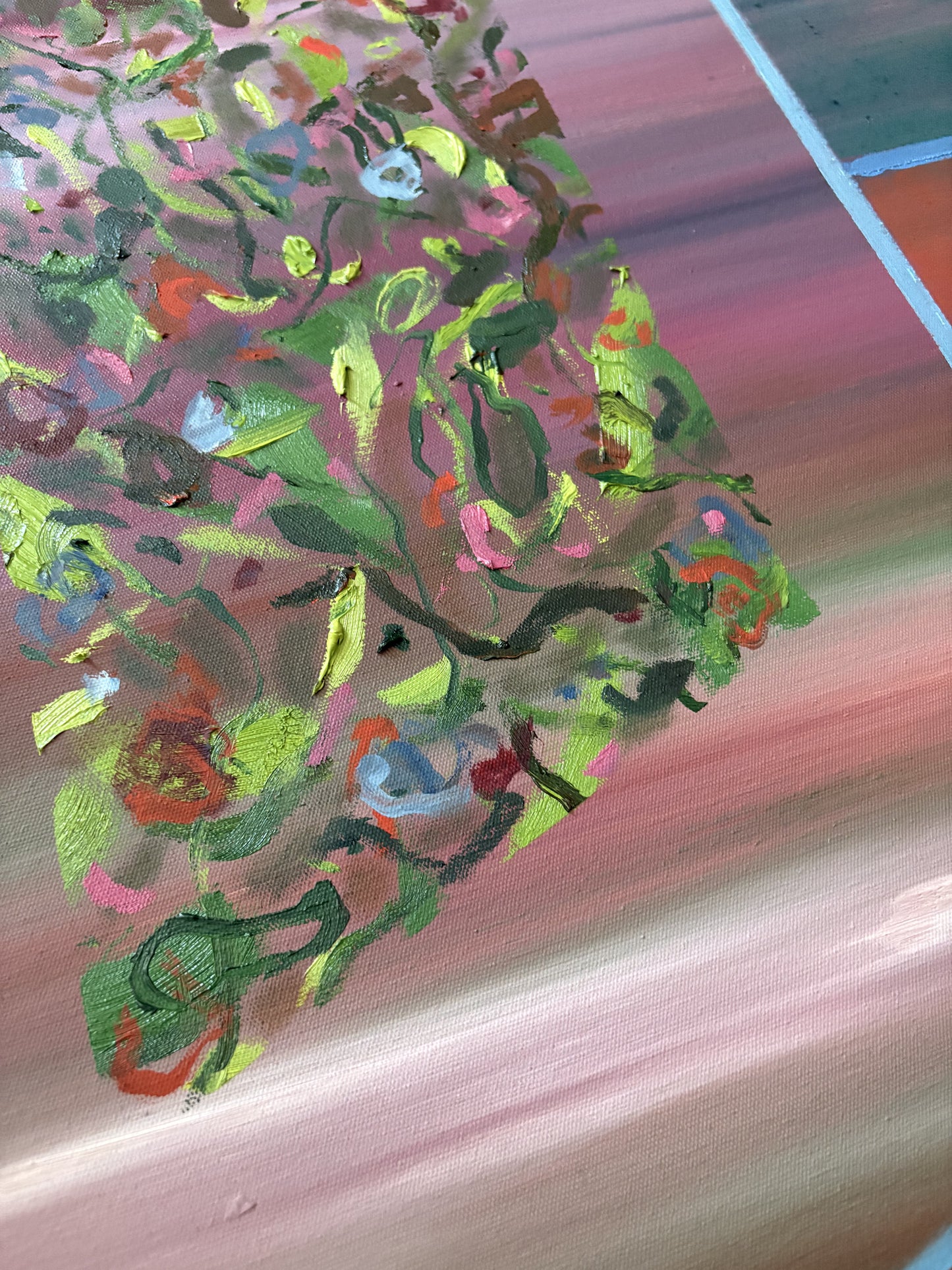
Layered washes of muted rose, sage, and atmospheric greys create a horizonless environment, dissolving boundaries between interior and exterior. Within this quiet structure, vertical forms composed of gestural, botanical strokes appear to hover — neither rooted nor fully detached — evoking traces of life passing through space. Their reflections and echoes on the ground surface suggest residue, memory, and the subtle imprint left by presence.
Duval holds tension between stillness and motion: the architectural lines provide order and containment, while the organic forms introduce rhythm, impermanence, and emotional resonance. The composition becomes a meditation on how we inhabit space — not only physically, but psychologically — and how fleeting movement shapes environments long after it has passed.
Poetic and atmospheric, The Space We Move Into reflects Duval’s ongoing exploration of spatial memory, presence, and the quiet traces we leave behind.
Description
In The Space We Move Into, Marie-Chloé Duval explores the invisible architecture shaped by movement, memory, and the transient presence of organic forms. Suspended floral-like fragments drift through a softly constructed geometric interior, where translucent planes and shifting perspectives suggest spaces that are both physical and psychological.
Layered washes of muted rose, sage, and atmospheric greys create a horizonless environment, dissolving boundaries between interior and exterior. Within this quiet structure, vertical forms composed of gestural, botanical strokes appear to hover — neither rooted nor fully detached — evoking traces of life passing through space. Their reflections and echoes on the ground surface suggest residue, memory, and the subtle imprint left by presence.
Duval holds tension between stillness and motion: the architectural lines provide order and containment, while the organic forms introduce rhythm, impermanence, and emotional resonance. The composition becomes a meditation on how we inhabit space — not only physically, but psychologically — and how fleeting movement shapes environments long after it has passed.
Poetic and atmospheric, The Space We Move Into reflects Duval’s ongoing exploration of spatial memory, presence, and the quiet traces we leave behind.